
Learning a new technology often feels like trying to read a map in a foreign language. When it comes to Artificial Intelligence, the headlines throw around dozens of overlapping buzzwords—models, engines, platforms, agents—that make everyday tools feel far more complicated than they actually are.
In my AI workshops, I tell my students that you don’t need a computer science dictionary to get practical help from AI. You just need four simple terms, one everyday analogy, and one important safety rule.
The Only Four Words You Need
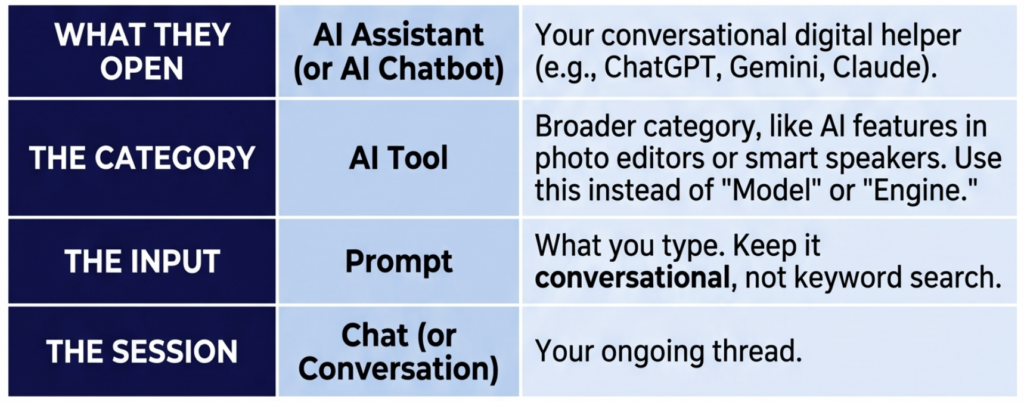
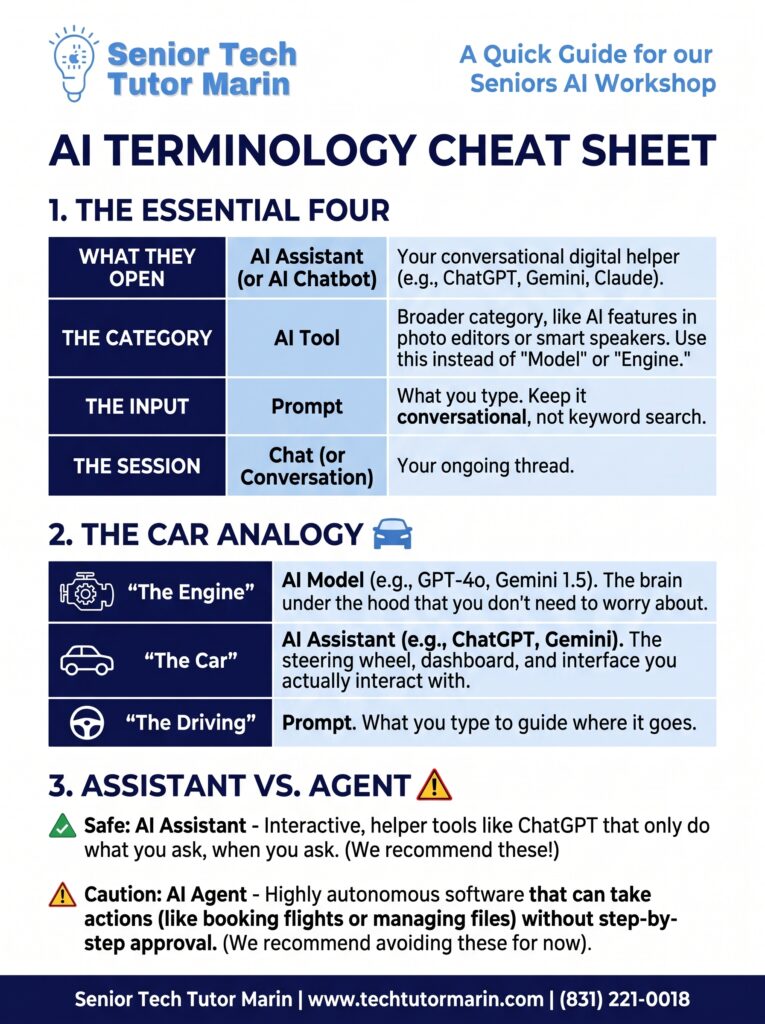
To cut through the noise, ignore the technical jargon and focus on the basics you will actually use at your keyboard:
- AI Assistant (or AI Chatbot): This is the website or app you open—tools like ChatGPT, Gemini, or Claude. Think of it as a conversational digital helper waiting for your instructions.
- AI Tool: This is the broader category for AI features built into things you already use, like a smart speaker or a photo editor that removes background clutter.
- Prompt: This is simply what you type into the box. Unlike a traditional Google search where you type two or three stiff keywords, a prompt works best when you write in full, conversational sentences—just as if you were asking a knowledgeable friend for help.
- Chat (or Conversation): This is your ongoing thread with the assistant. You don’t have to get the perfect answer on your first try; you can stay in the same chat and ask follow-up questions to refine what you need.
The Car Analogy
People often ask me about the difference between an “AI Model” and an “AI Assistant.” The easiest way to picture it is to think about driving a car.
An AI Model is the engine under the hood. It does the heavy technical lifting, and unless you are a mechanic, you don’t need to worry about how it’s built.
The AI Assistant is the car itself—the seats, the dashboard, and the steering wheel you actually sit down and interact with.
Your Prompt is the driving: turning the wheel and pressing the gas to tell the car where you want to go.
The One Safety Distinction: Assistant vs. Agent
As you read the news, you will start hearing a lot about AI Agents. It is worth knowing the difference between an Assistant and an Agent, because they operate very differently.
An AI Assistant is interactive and safe for everyday use. It sits quietly until you ask it a question, gives you a draft or an answer, and waits for your next instruction. You remain in the driver’s seat at all times.
An AI Agent, on the other hand, is autonomous software designed to take actions on your behalf—such as clicking buttons, managing files, or booking travel—without asking for your step-by-step approval.
For everyday personal use right now, I recommend sticking strictly to AI Assistants and steering clear of autonomous agents.
You don’t need to master the whole tech industry to benefit from these tools.
Keep your vocabulary simple, write your prompts like a normal conversation, and enjoy having a helpful new co-pilot at your desk.
Rob Shore is the founder of Senior Tech Tutor Marin (www.techtutormarin.com), providing one-on-one technology coaching and community workshops for older adults across Marin County. Have a tech question? Reach out at 831-221-0018.
Senior Tech Tutor Marin offers one-on-one, jargon-free help with iPhones, iPads, Macs, email accounts, passwords protection, photo organization, online accounts, and so much more. Our pricing starts at only $50.
Tech tutoring for seniors, by a senior.